

If I say “stock market,” what comes to mind?
For most people, it’s something like: “casino”, “gambling”, or “random”.
Ask 100 people what drives the market and you’ll hear everything from politics to Fed meetings, to “it’s all just noise.”
And I totally get it.
Russia invades Ukraine = Market up. What?!
Unemployment drops = Market down. How?!
In the short term, the market can feel completely disconnected from reality. Which begs the question: what actually drives the market?
Earnings.
What’s the single biggest factor in a stock’s long-term price? Earnings (the profitability of a company).
More specifically, prices reflect the expectations of future earnings.
If a company delivers better than expected, their stock tends to rise. If the company falls short, it tends to fall.
The market isn’t driven by “good” or “bad”. It’s driven by “better” or “worse”.
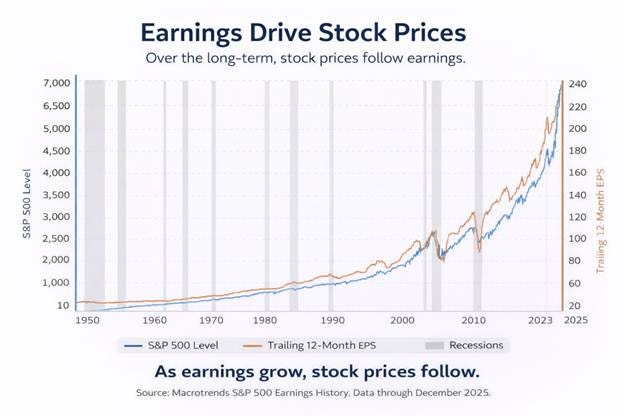
This is the fundamental idea behind investing.
When you buy a stock, you’re buying a piece of a business. And over time, the value of that business is driven by the profits it generates.
You can see it clearly in the data. When you map the S&P 500 against earnings per share*, they move closely together over time. As businesses become more profitable, their stock prices tend to follow.
In short: investors are participating in the growth of those businesses.
Why does this matter?
Because it puts everything into perspective. Even in the short term, market movements are tied to what investors think will happen to earnings.
Take Russia invading Ukraine. Markets became volatile because uncertainty around earnings spiked. Investors didn’t know how it would impact profitability.
As it became clear the impact on U.S. companies would be limited, investors could price it in and the market moved on.
Without this perspective, it feels random. Like a roulette wheel.
That’s why trading based on short-term “signals” is so difficult. You’re reacting to noise, not what actually drives long-term returns.
When you understand that you’re investing in businesses that generate profits over time, the short term starts to fade into the background.
Even short-term movements are tied to earnings — specifically, changing expectations about future earnings.
As the saying goes, in the short run the market is a voting machine. In the long run, it’s a weighing machine.
In the short run, expectations can shift quickly. In the long run, reality wins.
This is why the market has rewarded patience and discipline.
Or as Warren Buffett famously said, “The stock market is a device for transferring money from the impatient to the patient.”
Stay patient. In the end, earnings – not emotions – are what drive results.
*Earnings per share is just the profit attributable to each share of stock.
Past performance is no guarantee of future results. All written content on this site is for information purposes only. Opinions expressed herein are solely those of Ridley Wealth Management, LLC and our editorial staff. Material presented is believed to be from reliable sources; however, we make no representations as to its accuracy or completeness. All information and ideas should be discussed in detail with your individual adviser prior to implementation. Advisory services are offered by Ridley Wealth Management, LLC, a Registered Investment Adviser in the State of Texas. Being registered as an investment adviser does not imply a certain level of skill or training.
The presence of this website shall in no way be construed or interpreted as a solicitation to sell or offer to sell investment advisory services to any residents of any State other than the State of Texas or where otherwise legally permitted. All content is for informational purposes only. It is not intended to provide any tax or legal advice or provide the basis for any financial decisions. All investing involves risk including the possible loss of principal.